
What is Technology Improvement Rate?
Technology Improvement Rates (TIRs) are a metric that measures how quickly a technology is getting better over time - specifically, how much more performance per dollar you can expect from a technology each year. The higher the TIR, the faster a technology is improving.
Think of it like compound interest on a bank account. A technology with a high improvement rate compounds its performance gains year after year, just as money in a high-interest account grows exponentially. Technologies with low improvement rates inch forward slowly, while those with high rates can transform entire industries within a decade.
The science behind TIRs
In 2018, GetFocus worked with MIT to build the world's first objective technology forecasting system. MIT had long theorized that technological progress was predictable — but lacked the data to prove it. They began empirically measuring how fast technologies had actually improved across 28 domains, from solar panels to genome sequencing to combustion engines.
What they found was striking: all technologies improve exponentially, and at a consistent rate. Each technology has its own version of Moore's Law.
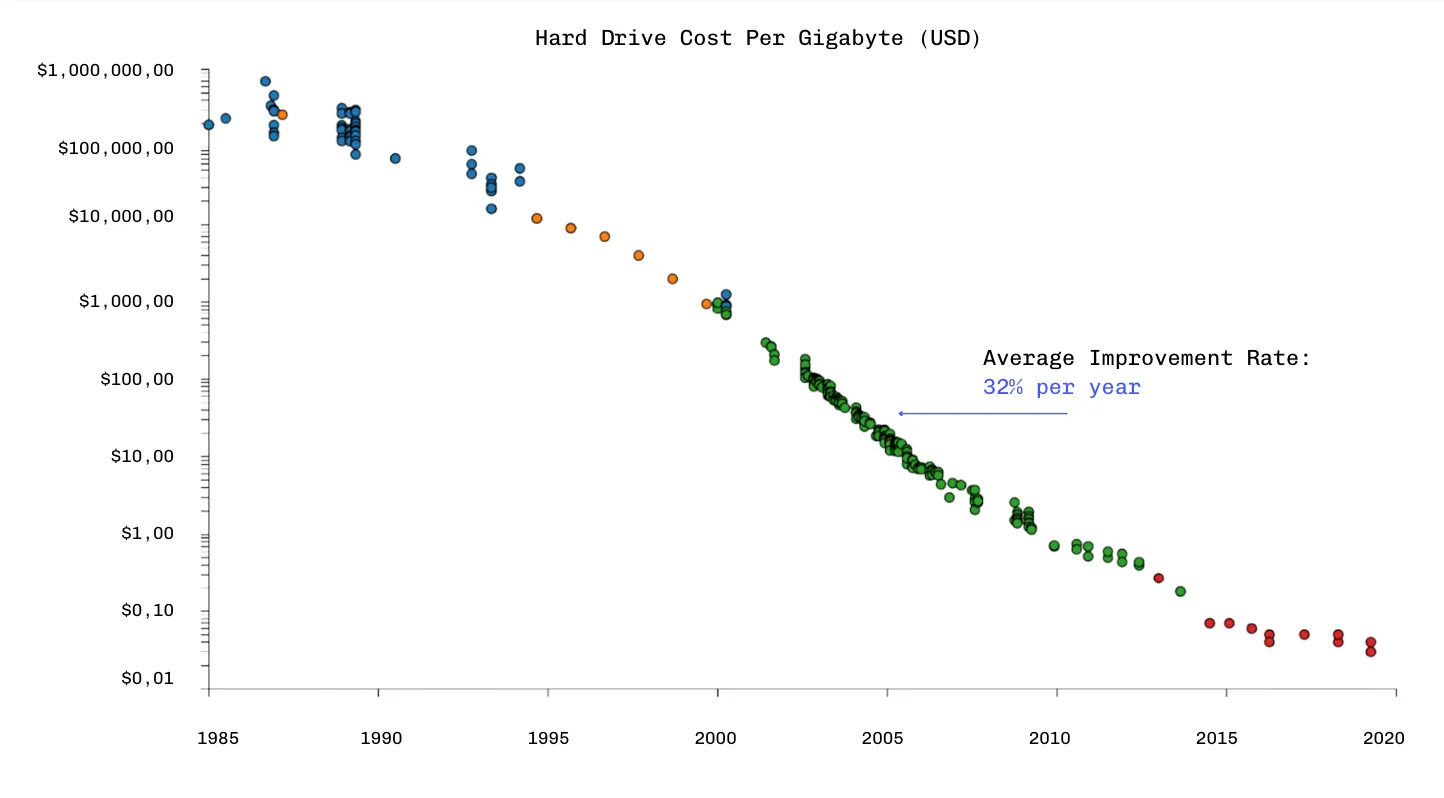
This consistency is what makes improvement rates so powerful. If you can measure the rate, you can forecast the future.
💡 What this means for strategy:
Executives should track a portfolio of technology trajectories, not just current business performance. Fast-improving technologies deserve earlier attention — pilots, partnerships, and option-like investments — even before broad market proof appears. The right question to ask is not "is this technology better now?" but "when does it become good enough for my use case?"
How TIRs are calculated
TIRs are derived from two key metrics hidden in patent citation data:
Cycle Time Measures how quickly a technology produces new generations of itself. It is calculated from backward citations - how many years passed between an invention and the prior inventions it improves upon. A short cycle time means a technology is iterating fast.
Knowledge Flow Measures how impactful new inventions are. It is calculated from forward citations - how often a patent gets cited by later inventions within 3 years of publication. Important inventions get cited quickly and often. A high knowledge flow means inventions in this space are building meaningfully on each other.
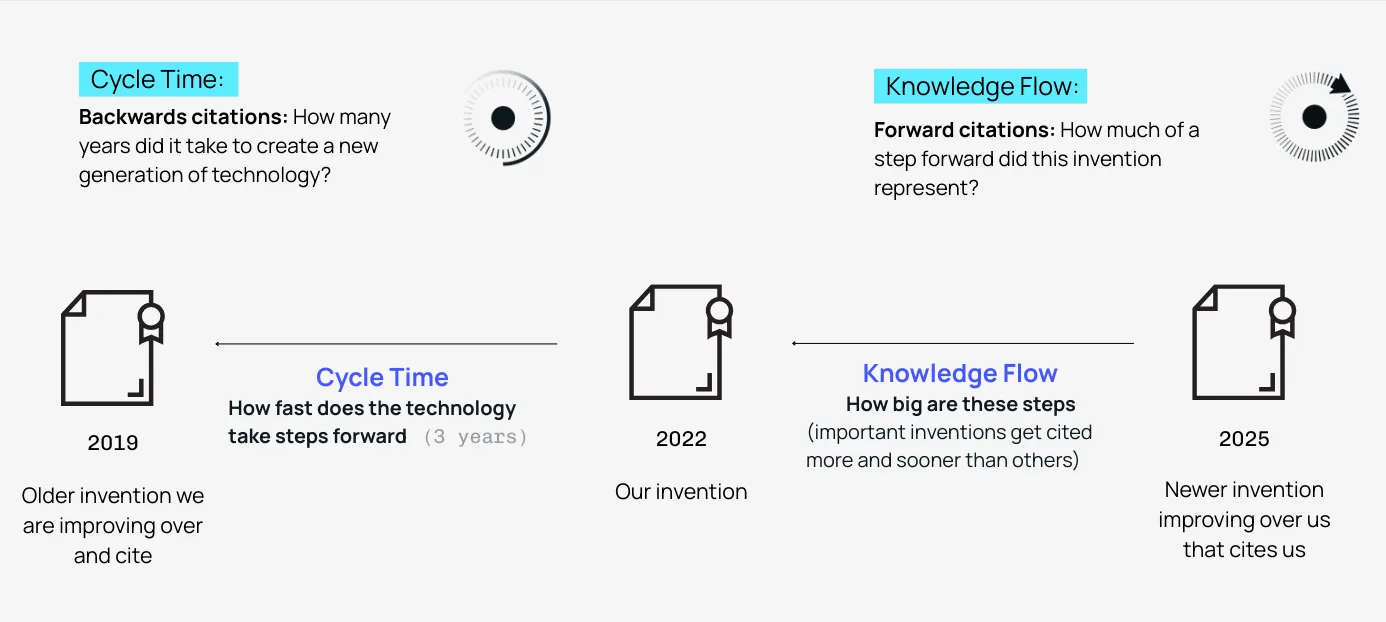
Together, these two metrics are highly predictive of a technology's improvement rate:
- Short cycle time + high knowledge flow = fast improvement
- Long cycle time + low knowledge flow = slow improvement
💡 GetFocus calculates Cycle Time and Knowledge Flow for every patent family in its database. This is the foundation for the TIR metric.
Why TIRs matter for technology strategy
TIR is a comparative metric - it only becomes meaningful when you compare competing technologies against each other. There is no universally "good" or "bad" improvement rate in isolation. What matters is whether your technology of interest is improving faster or slower than its competitors.
Historically, the fastest-improving technology out of a set of competing technologies is the one that ends up dominating the market.
💡 Note that adoption tends to accelerate when a technology becomes good enough for a valuable use case - not only when it becomes universally superior.
This means TIRs let you see the technological future before it has happened.
Real-world examples
Electric Vehicles vs. Hydrogen Fuel Cells
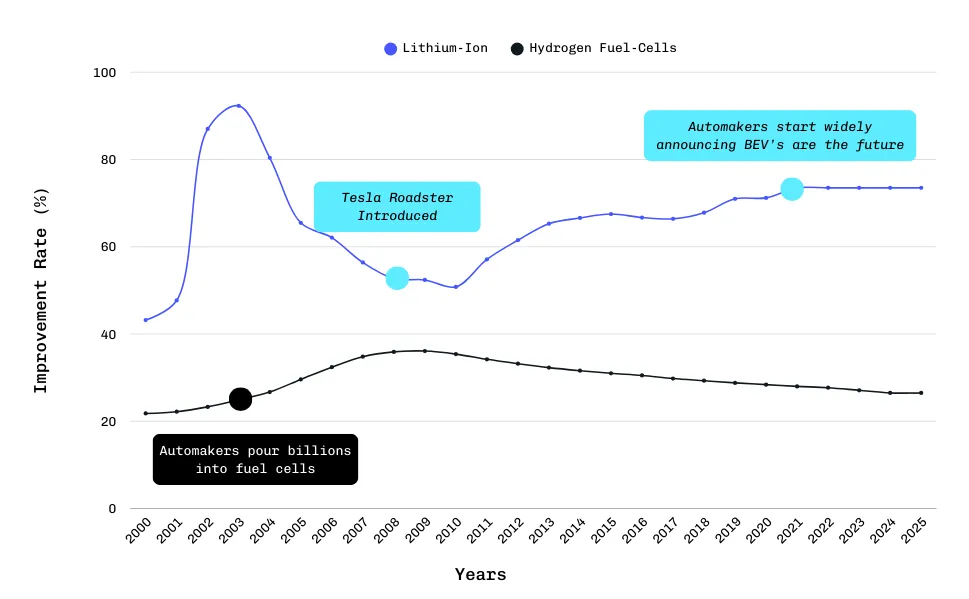
Lithium-ion batteries had been improving at a significantly higher rate than hydrogen fuel cells for decades. The signs of EV disruption were detectable as early as the 2000s — years before Tesla's Roadster launched and long before automakers started pouring billions into fuel cell development. TIRs would have pointed to the right bet early.
Online Payments vs. Cash
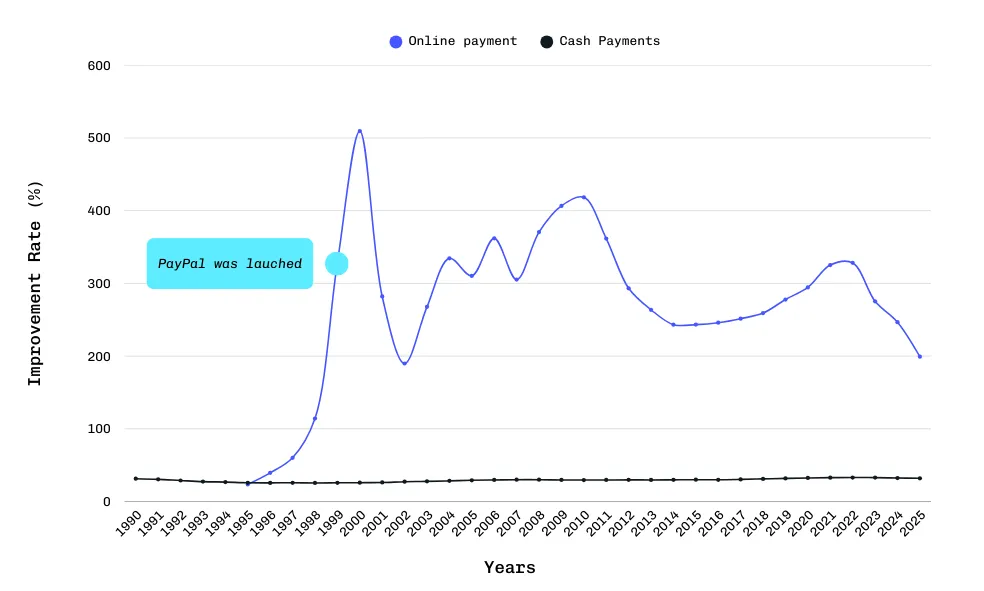
As early as 1996, improvement rates showed online payment technology advancing far faster than offline methods. PayPal's launch in 1998 and its rapid adoption confirmed what the data had already indicated.
How to use TIRs
Use TIR analysis to decide where to look, where to learn, and where to place strategic bets early. It is best used as a first-layer screen - a signal to prioritize attention and exploration.
Things to keep in mind
TIR is always relative. Always compare a technology's improvement rate against competing alternatives - never interpret it in isolation.
Dataset quality matters. A reliable TIR calculation requires a patent dataset of at least 50 families. The more patents, the more reliable the result.
Patent data has blind spots. The methodology is less reliable in domains driven by secrecy, tacit knowledge, or weak patenting behavior.
Timing is directional, not precise. TIRs are a comparative and directional tool. Exact crossover dates are uncertain.
Ready to use TIRs in practice? Explore the guides below:
Using TIR for Technology Strategy Using TIR for Technology Strategy - how to go from a technology question to a data-backed recommendation